Kuala Lumpur, November 28:
The South Asia Journalism Collective (SAJC), a collective of media organisations, was announced at the Global Investigative Journalism Conference 2025 (GIJC25) in Kuala Lumpur, Malaysia, to support cross-border investigations across the region.
The SAJC brings together media organisations from South Asia, home to 2.04 billion people. The founding members are: Center for Investigative Reporting (Sri Lanka), Digitally Right (Bangladesh), Media Unlimited (Pakistan), Nepal Investigative Multimedia Journalism Network (NIMJN) (Nepal), and The Reporters' Collective (India).
SAJC aims to foster collaboration among journalists and newsrooms in South Asia to investigate, capacitate, share resources, and defend media freedom in countries where journalists face mounting pressure. Journalistic collaborations have become extremely vital to foster understanding of a complex and diverse region where journalism is practiced at great risk and with limited resources, despite some of the finest and hardest reporting taking place in South Asia.
Rajneesh Bhandari– Founder and Chief Editor, Nepal Investigative Multimedia Journalism Network (Nepal), Kamal Siddiqi– Director, Media Unlimited, former Director, Centre for Excellence in Journalism (Pakistan), Miraj Chowdhury – Founder, Digitally Right; former Bangla Editor, Global Investigative Journalism Network (Bangladesh), Mayank Aggarwal– Editor, The Reporters' Collective (India), and Dilrukshi Handunnetti– Co-Founder and Director, Center for Investigative Reporting-Sri Lanka (Sri Lanka) are instrumental in convening and shaping the future of the South Asia Journalism Collective (SAJC).
SAJC is a powerful and timely initiative, says the executive director of GIJN
Emilia Díaz-Struck, Executive Director, Global Investigative Journalism Network (GIJN) welcomed the formation of the collective at a time investigative journalism is facing serious challenges in South Asia.

“During these complex times, collaborations and partnerships are key to strengthening the capacity of journalists to hold powers to account and conduct investigations of public interest that are valuable for citizens around the world,” Díaz-Struck said.
“We are excited to see that journalists from South Asia have joined forces to advance their work as a community in the region and celebrate the birth of the South Asia Journalism Collective. We see this as a powerful and timely initiative and look forward to seeing it grow and develop.”
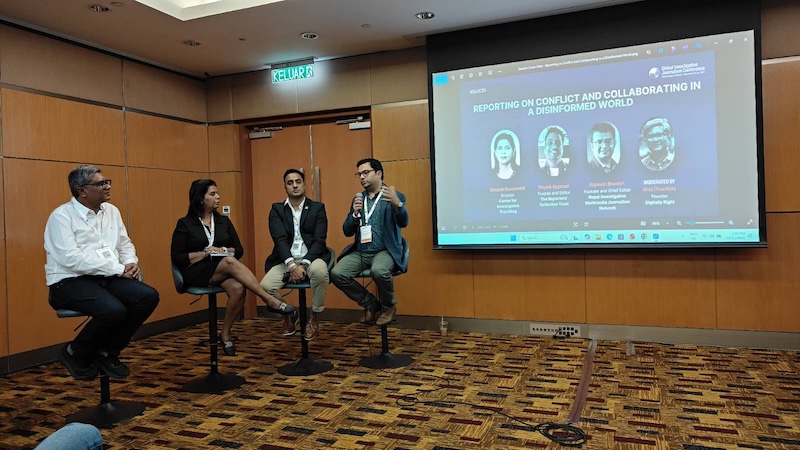
Four founding members participated in a GIJC25 panel on “Reporting on Conflict and Collaborating in a Disinformed World.”
The collective was also featured during the South Asia networking session where the need for evidence-based journalism, resource sharing, protection of media freedom, safety, and core values of accountability journalism were discussed.
"South Asia is a rapidly growing region, industrially and in democratic activities," said Yasuomi Sawa, GIJN's newly elected Asia/Pacific board member. "It is important for democracy and press freedom."